
Last Updated: November 1, 2026
Quick Summary
Grass fed tallow is not yet supported as an eczema treatment, since clinical guidance calls the evidence weak. It may soften dry skin for a short time, but it can irritate or sensitize eczema-prone skin, so patch-test it on the inner forearm for five to seven days first.
- Children's Hospital of Philadelphia says there is no strong evidence tallow treats eczema better than other options.
- Tallow may add a layer of moisture and make dry patches feel softer for a short time.
- Patch-test on the inner forearm, not the face, eyelids, neck or skin folds, on clean unbroken skin.
- Repeat the patch test daily for five to seven days, since sensitization can build after several applications.
- Stop using it if burning, spreading redness, swelling, new rash or weeping appears, and avoid it on infected or weeping skin.
Table of Contents
- Is Grass-Fed Tallow Good for Eczema? What the Evidence Shows
- Using Tallow for Eczema-Prone Skin: Who Should Be Careful
- How to Patch-Test Tallow Before Full Use
- Tallow Balm Side Effects and When to Stop Using It
- Choosing a Moisturizer for Eczema: Where to Start Your Trial
- Frequently Asked Questions
Many people with eczema ask whether grass fed tallow is good for eczema, and the evidence does not yet support it as a treatment. Tallow may feel soothing and moisturizing for some dry skin. Below is what the research and clinical guidance say, where tallow may help, and how to test it safely.
Is Grass-Fed Tallow Good for Eczema? What the Evidence Shows
What the research and clinical guidance say
Beef tallow is being promoted online as a natural eczema remedy, but the available sources describe its use as unproven. Children's Hospital of Philadelphia guidance on beef tallow and eczema
Children's Hospital of Philadelphia says there is no strong scientific evidence that beef tallow treats eczema better than other options.
Where tallow may help and where it falls short
A plain grass fed tallow balm may make some eczema-prone skin feel less dry.
Tallow may add a layer of moisture to dry patches and may make skin feel softer for a short time.
Using Tallow for Eczema-Prone Skin: Who Should Be Careful
Tallow is an animal-derived fat, which matters for eczema-prone skin in ways a plant oil or conventional emollient does not. You can find a specific tallow face cream to consider only after checking these cautions. A heavy, occlusive balm that feels fine on intact dry skin can trap heat, sweat, and bacteria on broken or inflamed skin, and a protein residue from the source animal can trigger sensitization in someone who has never reacted to beef on a plate.

Why eczema skin changes the risk
Practitioners describe a two-stage reaction: the first application causes no problem, then after several days of repeated use redness, itching, or small bumps appear because sensitization built up. This is why a single spot test on day one is not enough.
Presentations and body areas that need different care
-
Actively weeping, oozing, or crusted eczema. This can signal infection or severe barrier breakdown, and a sealed occlusive balm can trap moisture and bacteria. See a clinician before applying any new topical product.
-
Cracked or fissured skin (hands, heels, knuckles). A balm may help seal the fissure, but deep, bleeding, or painful cracks need assessment.
-
Eyelid and periocular eczema. The highest-risk zone: skin is very thin, reactions are hard to treat, and product migrating into the eye causes irritation. Ask a clinician first.
-
Scalp and hairline. Occlusive balms can be hard to wash out and may worsen seborrheic-type flaking. Patch-test on the forearm, not the scalp.
-
Skin folds (behind the knees, elbow creases, under the arms). Heat and sweat accumulate here and a heavy balm can cause maceration. Use sparingly, if at all.
Who should be extra careful
- People with a known allergy to beef, dairy, or animal fats. Cross-reactivity is possible, and a tallow balm is a concentrated animal-derived product.
- People with a history of allergic contact dermatitis to lanolin, fragrances, or preservatives. Tallow balms vary widely in additives, which are often the actual culprit.
- Babies and young children. Infant skin is thinner and more permeable. Speak to a pediatric clinician before introducing any new topical product, and do not use a tallow balm on broken or oozing infant skin.
If you have a severe, spreading, or rapidly worsening flare, or any signs of infection such as warmth, pus, or fever, see a doctor before trying any home product. Tallow is not a substitute for prescribed eczema care.
How to Patch-Test Tallow Before Full Use
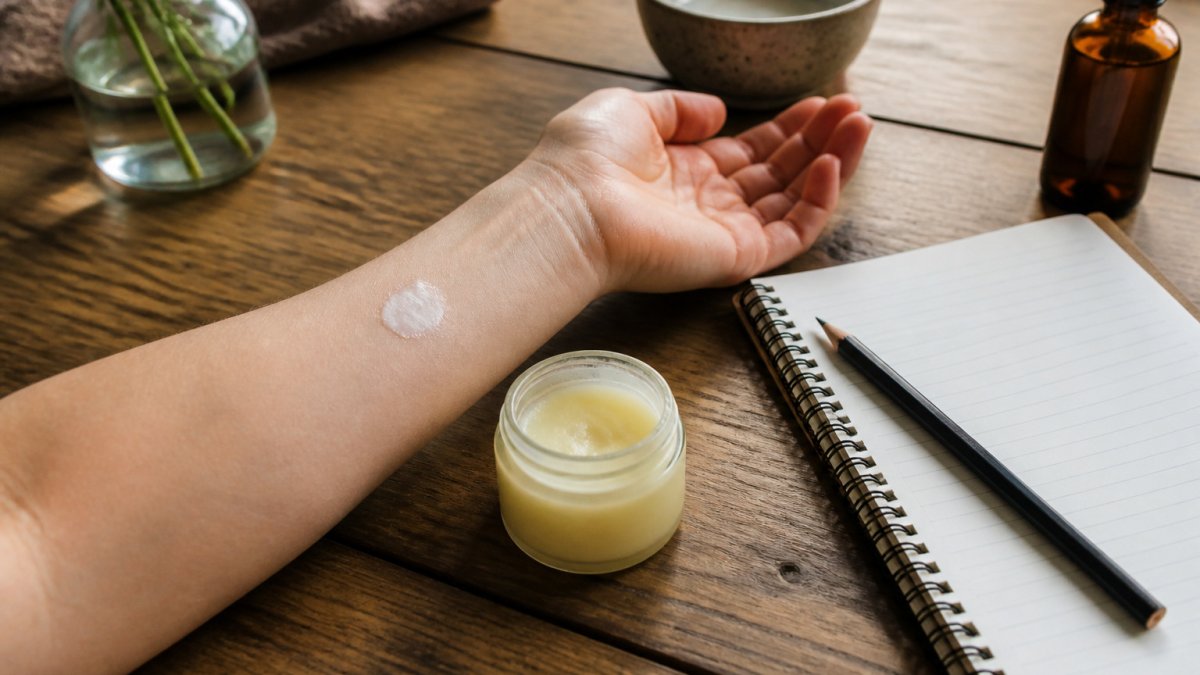
Patch testing is a useful step before committing a tallow balm to a large area of eczema-prone skin. Below is a protocol you can follow, plus the stop-use criteria that tell you when to abandon the trial.
ZOLENA Grass-Fed Tallow Face Cream - 50 mL →
What patch testing can and cannot tell you
A patch test answers one question: does this product cause an immediate irritant reaction or a delayed allergic reaction on a small area of my skin? It does not tell you whether the product will treat eczema, outperform your current moisturizer, or suit every body area. Treat a pass as permission to trial, not proof of safety everywhere.
Step-by-step protocol
- Choose the right test site. The inner forearm is standard: thin enough to react, thick enough to tolerate a small amount, easy to observe. Do not test on the face, eyelids, neck, or skin folds for a first trial.
- Start with clean, cleared skin. Do not patch-test on an active flare, an open scratch, or broken skin. If your eczema does not settle, see a clinician rather than testing on inflamed skin.
- Apply a thin layer to a small area, roughly the size of a coin. Do not occlude it with a bandage unless deliberately testing under occlusion, which raises reaction risk.
- Leave it on and observe. Check at 15 to 30 minutes for an immediate reaction, then again at 24, 48, and 72 hours. Delayed allergic reactions commonly appear between 24 and 72 hours.
- Repeat daily for five to seven days if there has been no reaction, applying to the same small site. This catches the sensitization pattern where the first few applications are fine and a reaction builds over the week.
- Record what you see. Note redness, itching, swelling, bumps, weeping, or texture changes. A photo taken at the same time each day is more reliable than memory.
Warning signs and stop-use criteria
Stop using the product and wash the area with lukewarm water and a mild, fragrance-free cleanser if you see any of the following:

- Immediate stinging or burning that does not settle within a few minutes.
- Spreading redness that extends beyond the application site.
- Swelling, hives, or raised welts.
A mild, transient tingling that fades within minutes is not the same as a reaction, but it is a reason to re-check at 24 hours. Do not push through a reaction to "see if it settles."
If a reaction develops
For a mild reaction, stop the product, wash the area, and apply a plain, fragrance-free emollient you already tolerate. For a reaction that is spreading, painful, blistering, or accompanied by swelling of the face or lips, seek medical care. If you have a known history of severe allergic reactions, do not patch-test at home without clinical guidance.
What a pass means for the rest of the trial
If the seven-day patch test is clear, you can begin using the balm on a larger area, but keep the trial structured. Apply it to one body region at a time, check daily, and give it two weeks before judging whether it helps.
The article lays out a patch-test protocol and stop-use criteria, summarised here so you can see the key timings at a glance.
| Step | What to do | Time or frequency |
|---|---|---|
| Choose test site | Use the inner forearm, not face or folds | Before first use |
| Start clean | Test only on cleared, unbroken skin | Before first use |
| Apply | Thin layer about the size of a coin | Once to begin |
| Observe early | Check for immediate reaction | 15 to 30 minutes |
| Observe delayed | Check for allergic reaction | 24, 48 and 72 hours |
| Repeat | Reapply to same small site if no reaction | Daily for five to seven days |
| Record | Note redness, itching, bumps or weeping | Daily, photo at same time |
Tallow Balm Side Effects and When to Stop Using It
Stop using tallow balm if irritation occurs. Common warning signs include:
- Burning or stinging after application
- New redness or rash
- Increased itching or flaking
Do not keep using a product that makes eczema worse.
Choosing a Moisturizer for Eczema: Where to Start Your Trial
Start with a simple, fragrance-free moisturizer if you have eczema. If you want a body-size tallow option for a trial, you can view the ZOLENA Tallow Body Cream. Tallow can be one option to test, but it should not replace guidance from your doctor or dermatologist.

Compare options using a short checklist:
- Does it contain fragrance or essential oils?
- Does the ingredient list include animal fats you react to?
- Can you patch-test it on a small area first?
Frequently Asked Questions
Should I put beef tallow on my eczema?
Tallow may make some dry, eczema-prone skin feel less dry, but the available sources do not show that it treats eczema or works better than established moisturizers. If you want to try it, patch test first and stop if redness, itching or swelling appears. If your eczema is active or not improving, see a healthcare provider for guideline-based care.
Is tallow safe to use on a baby's eczema?
The sources available do not establish that tallow is safe or effective for a baby's eczema. Because infant skin is delicate, speak with a pediatrician or dermatologist before using any new product on a baby with eczema, and do not replace prescribed treatment with tallow.
Can grass-fed tallow make eczema worse?
Signs to watch for include increased redness, burning, swelling, new bumps or more itching after application. If any of these occur, stop using the product, wash the area gently with a mild, fragrance-free cleanser and contact a healthcare provider if symptoms persist or spread.
How do I patch-test tallow on sensitive skin?
Apply a small amount of tallow balm to a discreet area, such as the inner forearm or behind the ear, once or twice daily for several days. Leave it uncovered and avoid rubbing it in vigorously. Check the area at 24, 48 and 72 hours for redness, itching, swelling or bumps. If none appear, you can try it on a slightly larger area. Stop immediately if a reaction develops.
Ready to try a gentler option for dry skin? Explore the Glow Trio to see a bundle of tallow-based products you can test on your own schedule.


