
Last Updated: October 31, 2026
Quick Summary
No honest source can call tallow non-comedogenic for everyone, because comedogenic ratings are lab predictions, not verdicts for your face. Research notes tallow is marketed as non-comedogenic while stating that classification warrants further study, so treat any tallow non-comedogenic claim as unproven and patch test first.
- Comedogenic ratings come from animal-ear or similar test models using isolated ingredients, often at full strength.
- A 2025 study of beef tallow skincare claims states its non-comedogenic classification warrants further study.
- Oily and acne-prone skin is the highest-risk group; keep tallow off the congested center of the face.
- Patch test a pea-sized amount on the inner forearm or behind the ear for 48 hours.
- New blackheads or whiteheads over one to two weeks in treated areas are the signal to stop.
Table of Contents
- What Comedogenic Means and Why the Label Is Not a Verdict
- Is Tallow Non-Comedogenic? What the Evidence Shows
- Does Beef Tallow Clog Pores? Balm, Soap, and Formulation Differences
- Beef Tallow for Acne-Prone Skin: Risks and Realistic Expectations
- Negative Effects of Tallow on Skin and How to Spot Them Early
- How to Use Tallow Balm on Face: A Patch-Test Protocol
- Frequently Asked Questions
What Comedogenic Means and Why the Label Is Not a Verdict
The short answer to whether tallow non-comedogenic claims hold up for skin is that no honest source can give a universal yes or no. Comedogenic describes a substance's tendency to clog pores, which depends on the substance, concentration, rest of the formula, and the person.
Comedogenic means capable of contributing to comedones, the blocked pores that show up as blackheads and whiteheads. A comedogenic rating is a prediction from lab models and patch studies, not a diagnosis of your face.
The Comedogenic Rating Scale and Its Limits
The 0-to-5 scale is a useful shorthand and a poor verdict. Ratings come from animal-ear or similar test models, using the ingredient in isolation and often at full strength. Real skincare is neither: a rich butter diluted into a light carrier behaves differently from the raw material in a lab dish.
The scale also ignores dose, frequency, and you. A thin layer over dry cheeks differs from a thick overnight mask, and sebum output, barrier health, hormones, and climate all shift how a face responds.
Is Tallow Non-Comedogenic? What the Evidence Shows
No. The evidence does not support calling tallow universally non-comedogenic, and it does not support calling it universally pore-clogging either.
Read that carefully. The claim you see most often online is the one the research says needs more work. Dermatology commentary agrees that both blanket claims, "clogs pores" and "never clogs pores," go beyond the available data (Scenic Dermatology on beef tallow for skin).
Tallow's Fatty-Acid Profile and Skin Compatibility
Tallow is mostly saturated and monounsaturated fat. Rich, occlusive balms can soften dry patches, which is why ZOLENA's tallow products are formulated for dry skin.
Compatibility is not safety for every skin type, though. For the fatty-acid benefit in a lighter format, ZOLENA's Glow Serum pairs squalane, jojoba, rosehip, argan, and vitamin E and is made without added fragrance or essential oils.

Does Beef Tallow Clog Pores? Balm, Soap, and Formulation Differences
Whether beef tallow clogs pores depends far more on product format and ingredient list than on the word "tallow." A tallow balm is an occlusive leave-on product; a tallow soap is a wash-off cleanser on the skin for seconds, so its pore-clogging potential is a different question.
Formulation is where the real differences live. Consider what else is in the jar:
| Format | How it sits on skin | Key formulation factors | Best for |
|---|---|---|---|
| Tallow balm | Leave-on, occlusive, rich texture | Carrier oils, butters, petrolatum, fragrance | Dry skin, dry patches |
| Tallow cream | Leave-on, medium-rich | Emollients, emulsifiers, vitamin E | Daily facial moisturizing |
| Tallow soap | Rinse-off, seconds of contact | Saponified fats, superfat level | Cleansing, not moisturizing |
| Tallow plus actives | Leave-on, treatment layer | Peptides, honey, botanical extracts | Targeted care, patch test first |
ZOLENA's GHK-Cu Tallow Honey Balm combines beef tallow, shea butter, and petrolatum with other ingredients, and suits different skin than its face cream. ZOLENA's GHK-Cu Tallow Honey Balm lists its full ingredient list, so you can judge the formula for yourself.

Beef Tallow for Acne-Prone Skin: Risks and Realistic Expectations
For acne-prone skin, tallow is a calculated risk rather than a safe default. Its occlusive richness can trap sebum on some skin, so caution is worth exercising if you already battle breakouts.
Separate the skin conditions before you decide
Acne-prone, oily, dry, sensitive, and barrier-impaired skin do not respond the same way to an occlusive balm. Treat them as different use cases:
- Oily and acne-prone skin: the highest-risk group. If you try tallow at all, keep it off the congested center of the face (nose, chin, between the brows) and reserve it for dry outer cheeks or the body. A lighter cream or squalane-based oil is usually a better first step.
- Dry skin without active breakouts: the most suitable group. A thin layer over dry patches can soften and comfort, provided you introduce it slowly.
- Sensitive or reactive skin: the risk is irritation rather than congestion. Fragrance, essential oils, and botanical extracts are common triggers, so read the full ingredient list before patch testing.
A stepwise acne-safe trial, not just "use moderation"
A cautious trial is more useful than a general warning. This plan is designed so that if you do react, you can identify the cause and stop early:
ZOLENA Grass-Fed Tallow Face Cream - 50 mL →
- Clear the baseline. Start when your skin is relatively calm, not mid-flare, and note current blackheads, whiteheads, and texture for comparison.
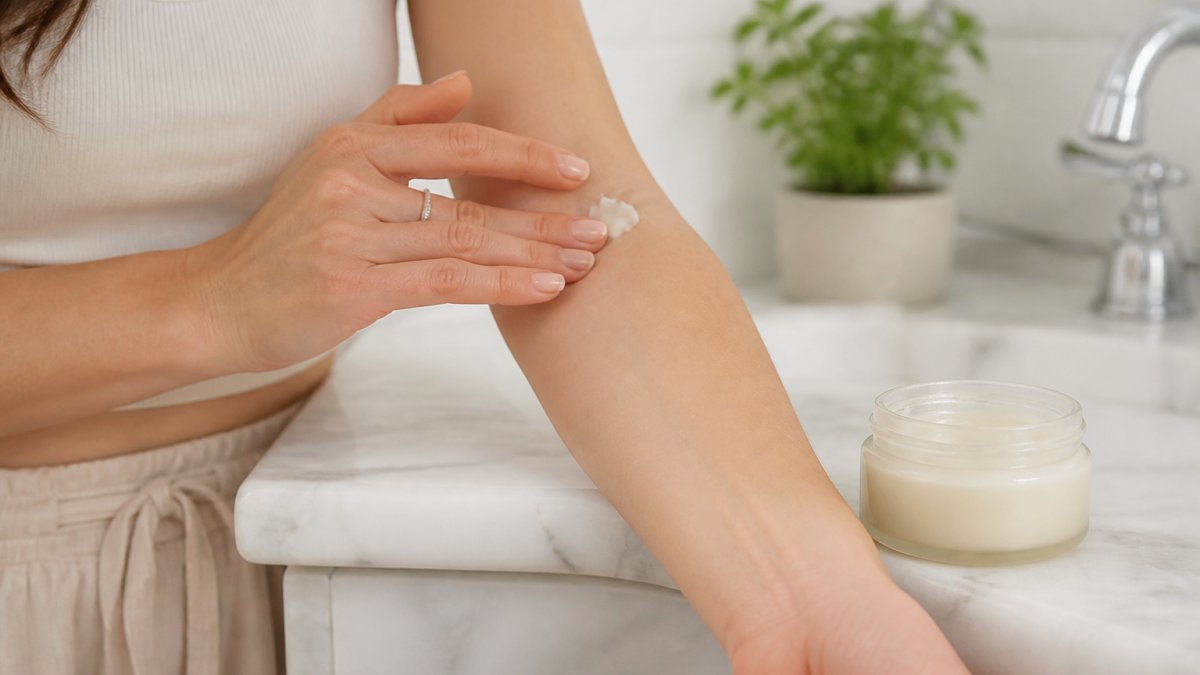
- Patch test away from the face first. Apply a pea-sized amount to the inner forearm or behind the ear for 48 hours. Stop if you see redness, itching, stinging, or bumps.
- One small facial area. Apply a thin layer to a single dry patch on the outer cheek, once daily for three to four days. Do not apply to the T-zone.
- Watch for congestion, not just irritation. New blackheads or whiteheads in the treated area over one to two weeks are the signal to stop; redness or stinging means stop immediately.
- Expand only if clear. If the test area stays clear after two weeks, extend to other dry areas in a thin layer, keeping the congested center of the face out of the routine.
- Stop and reassess if anything worsens. Persistent breakouts, cyst-like bumps, or spreading redness mean stop the product and, if it does not settle, consult a dermatologist.
Formulation matters as much as the word "tallow"
A pure tallow balm and one cut with jojoba, squalane, or a light carrier oil behave differently on acne-prone skin. Waxes, fragrances, essential oils, and heavy butters add their own congestion or irritation risk, so read the full ingredient list. For a lighter companion product, ZOLENA's Glow Serum pairs squalane, jojoba, rosehip, argan, and vitamin E without added fragrance or essential oils, and the ZOLENA Glow Trio bundles three products.
Negative Effects of Tallow on Skin and How to Spot Them Early
Any rich product can cause problems when used on the wrong skin or in too large an amount, so start small. But "negative effect" covers several different problems that call for different responses.
Three categories, three responses
1. Congestion (clogged pores). New blackheads or whiteheads where you applied the balm, appearing over one to two weeks, plus rougher texture.
2. Irritation (sensitivity reaction). Redness, stinging, itching, or warmth shortly after application, often from a fragrance, essential oil, or botanical extract.
3. Allergic or more serious reaction. Swelling, hives, spreading rash, blistering, or inflammation that worsens rather than settles.
Early signals to watch for
- New blackheads or whiteheads in treated areas over one to two weeks.
- Clogged pores and rougher texture than before you started.
- Redness, stinging, or itching shortly after application.
- Breakouts along the jawline or hairline, common where a heavy product migrates.
- Cyst-like bumps or spreading inflammation, which warrant stopping the product and speaking to a professional.
When to stop and when to seek professional care
Stop the product and consult a dermatologist if:
- Breakouts persist or worsen after you stop using the balm.
- You develop cyst-like bumps, spreading redness, or swelling.
- You suspect an allergic reaction (hives, blistering, rash that spreads beyond the application area).
Most people who react badly to tallow did not have a tallow problem; they had a testing problem. They slathered a rich balm across a full face on day one and had no way to tell what went wrong. Introduce one product at a time, keep a short log, and treat congestion and irritation as the different signals they are.
How to Use Tallow Balm on Face: A Patch-Test Protocol
Use tallow balm on the face in a thin layer, on clean skin, after patch testing on a small area for at least 48 hours. Here is the protocol we recommend, step by step:
Total time: about 10 minutes of hands-on effort across five days.
What you'll need: your tallow balm, a gentle cleanser, and a notebook or phone note to record reactions.
- Day 1, patch test. Apply a pea-sized amount to the inner forearm or behind the ear for 48 hours. [Time: 2 minutes] Expected result: no redness, itching, or bumps.
- Day 3, small facial area. Apply a thin layer to one dry patch on the cheek only, once daily for two days. [Time: 2 minutes daily] Expected result: comfort and softening, with no new congestion.
- Day 5, expand gradually. Add the balm to the rest of the dry areas of the face and neck, still in a thin layer. [Time: 3 minutes] Expected result: soft, conditioned skin without a heavy residue.
- Week 2, review. Check for blackheads, whiteheads, or texture changes before continuing.
If you want a specific product to run this protocol on, ZOLENA's grass-fed tallow face cream is intended for dry skin on the face and neck, and its listing advises patch testing before first use, especially for sensitive skin.

At ZOLENA, we handcraft our tallow skincare in small batches with grass-fed beef tallow and simple ingredients, and we recommend starting with a patch test.
Frequently Asked Questions
Does beef tallow clog pores?
There is no controlled evidence that settles this either way. The evidence on this is limited, and the non-comedogenic label has not been firmly established either way. Treat any blanket claim, in either direction, as unproven and patch test on your own skin.
Is tallow suitable for acne-prone skin?
It depends on your skin and the formula. Tallow is a rich product, so caution is worth exercising on acne-prone or oily skin. If you want to try it, start with a thin layer on one small area, use it only on dry patches rather than the whole face, and stop if you see new blackheads, whiteheads, or inflammation within two weeks. Anyone with active or cystic acne should speak to a dermatologist first.
What are the negative effects of tallow on skin?
The most commonly reported issues are pore congestion, breakouts, and irritation, usually in people with oily or acne-prone skin. A heavy application of a rich product can feel greasy. Some users react to added ingredients rather than the tallow itself, such as fragrance or essential oils. Patch test first, apply a thin layer, and stop use if irritation or new breakouts appear.
How should you patch-test tallow balm before using it on your face?
Patch test a small amount on a discreet area of skin before first use, and stop use if irritation occurs. Keep the rest of your routine unchanged during the test so you can tell what caused a reaction. Stop use if irritation occurs.


