
Last Updated: October 26, 2026
Quick Summary
Natural skincare for eczema-prone skin should support the skin barrier, reduce water loss, and avoid known irritants such as fragrance, essential oils, and harsh soaps. Keep the routine short: cleanse gently with lukewarm water, then moisturize damp skin at least twice daily. Patch test one new product at a time, spaced about a week apart.
- Keep showers short, ideally under ten minutes, and use lukewarm rather than hot water.
- Apply moisturizer within a few minutes of bathing, while skin is still slightly damp.
- Introduce one new product at a time, spaced about a week apart, and check for reactions at 24 and 48 hours.
- During a flare, subtract products; between flares, add them one at a time.
- Fragrance-free is the safer label claim, since unscented can mean a masking fragrance was added.
Table of Contents
- What Natural Skincare for Eczema-Prone Skin Should Actually Do
- A Gentle Eczema Skincare Routine, Step by Step
- Ingredients to Avoid for Eczema-Prone Skin
- Tallow Balm for Eczema: What It Can and Cannot Do
- Patch Testing Skincare Before It Touches a Flare
- Building Your Gentle Moisture Routine with ZOLENA
- Frequently Asked Questions
What Natural Skincare for Eczema-Prone Skin Should Actually Do
Natural skincare for eczema-prone skin should support the skin barrier, reduce water loss, and avoid known irritants. Everything else, botanical extracts, cold-pressed oils, the small-batch story, is secondary. At ZOLENA, we build our tallow-based products around that idea.
Here is the uncomfortable truth most ingredient lists avoid: "natural" and "gentle" are not the same thing. A review of eczema treatment published in the medical literature recommends avoiding known irritants such as soaps, detergents, chemicals, wool or nylon clothing, and sudden changes in temperature or humidity, none of which care whether an ingredient grew in a field. review of atopic eczema treatment
Below, we'll show you how to build a routine that respects a reactive barrier, which ingredients to avoid, and how to introduce anything new safely.
Why the Skin Barrier Matters More Than the Ingredient List
The skin barrier is the outer layer that holds moisture in and keeps irritants out. When it is compromised, water escapes and triggers slip past, which is why dry skin, itch, redness, and inflammation arrive together.
Harvard Health recommends thick creams and ointments, including plain petroleum jelly, and warns that fragrances and harsh ingredients in soaps, lotions, and detergents can set off flares. Harvard Health guidance on eczema skin care Notice what that advice is not: it is not a hunt for the most exotic plant extract.
A common mistake is treating a flare as a signal to try more products. The opposite works better: strip back to a gentle cleanser and one thick moisturizer, then rebuild only if your skin stays calm.
A Gentle Eczema Skincare Routine, Step by Step
The best eczema skincare routine is short: cleanse gently, moisturize while skin is still damp, and repeat daily. Most people need two products, not seven.
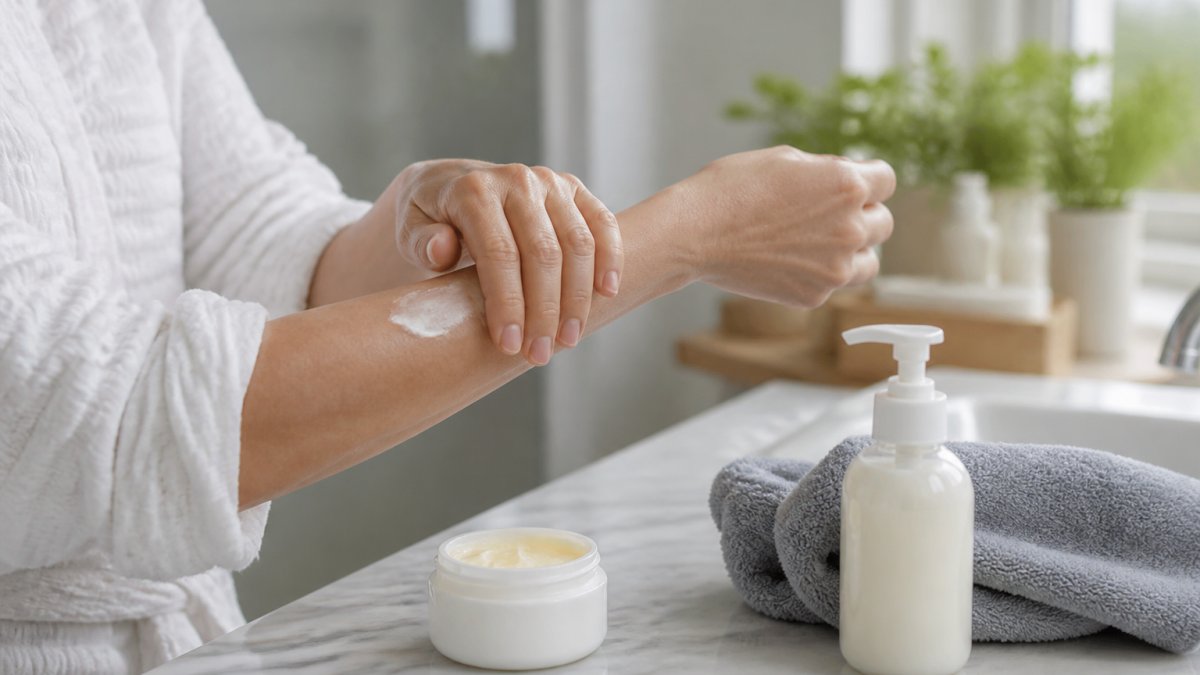
- Cleanse with lukewarm water. Hot water strips lipids. Keep showers short, ideally under ten minutes.
- Skip scrubbing. No loofahs, no exfoliating brushes, no harsh soap on reactive areas.
- Pat dry, don't rub. Leave skin slightly damp.
- Apply moisturizer within a few minutes. Damp skin absorbs and holds better.
- Layer a thicker occlusive on the driest patches. Elbows, knees, and hands usually need more.
- Repeat at least twice daily. Consistency beats intensity.
Bathing is not the enemy. Long, hot, soapy baths are. A short lukewarm wash followed immediately by moisturizer is one of the most reliable habits you can build.
The Routine Changes by Body Area and Flare Severity
The face, hands, and body have different needs, and a calm week looks different from a flare week.
By body area:
- Face. Thinner skin, more visible reactions, more product exposure. Use a fragrance-free cream rather than a heavy ointment during the day, keep the routine to cleanser plus one moisturizer, and apply a mineral, fragrance-free sunscreen after moisturizer.
- Hands. Frequent washing makes hands the first place to crack. Keep a fragrance-free hand cream at every sink and reapply after each wash. Ointments work overnight under cotton gloves.
- Body. Trunk and limbs tolerate thicker creams and ointments better than the face. Apply within three minutes of bathing, while skin is still damp, with a thicker layer on shins, elbows, and knees.
By severity:
- Calm skin (maintenance). Cleanse gently once daily, moisturize twice daily, and keep one occlusive for dry patches. This is the phase to patch test new products, because a reaction is easier to spot against a stable baseline.
- Mild flare (dry, itchy, no broken skin). Strip back to cleanser plus one thick moisturizer. Pause serums, exfoliants, or botanical oils. Increase moisturizer frequency rather than adding products.
- Moderate to severe flare (weeping, hot, spreading, or sleep-disrupting itch). Stop experimenting. Use only products you already know your skin tolerates, and seek advice from a qualified healthcare professional. Skincare is supportive care at this stage, not treatment.
Introducing New Products Without Gambling on a Flare
When your skin is calm, introduce one new product at a time, spaced about a week apart. Patch test on the inner forearm first, then a small area of the face or affected body part, noting the date, product, and any reaction at 24 and 48 hours. If you react, stop and wait until your skin settles before testing anything else, slower than buying a full routine at once, but the only way to know which product is responsible.
Ingredients to Avoid for Eczema-Prone Skin
The ingredients to avoid for eczema-prone skin are fragrance, essential oils, drying soaps and detergents, and anything that stings on contact. This is where natural skincare gets tricky, because several culprits are plant-derived and marketed as gentle.
Here is what each one does to a reactive barrier, and how to spot it on a label:
- Added fragrance and perfume. Fragrance mixes are among the most common causes of allergic contact dermatitis. Look for fragrance, perfume, parfum, and aroma on labels. "Natural fragrance" and "essential oil blend" are not safer alternatives; they are the same category of risk with different marketing.
- Essential oils. Citrus, peppermint, eucalyptus, lavender, tea tree, and geraniol are recognizable irritants and allergens. Their volatile compounds can penetrate a compromised barrier and provoke itching or redness. A product can be 100% natural and still trigger a flare.
- Harsh soaps and detergents. Traditional bar soaps and sulfate-heavy cleansers raise skin's pH and strip lipids, leaving skin tight and more permeable. Look for syndet (synthetic detergent) bars or fragrance-free liquid cleansers labeled for sensitive skin.
How to Read a Label Without Getting Fooled
Ingredient lists are ordered by concentration, so the first five ingredients tell you most of what you need to know. A cream starting with water, glycerin, and a bland oil is a different product from one starting with water, fragrance, and a botanical extract blend.
Watch for these patterns:
- "Fragrance-free" versus "unscented." Unscented can mean a masking fragrance was added to cover raw-material smells. Fragrance-free is the safer claim, but check the list anyway.
- "Natural" and "organic" claims. Neither term is a safety standard. A product can be certified organic and still contain essential oils that irritate eczema-prone skin.
- Preservatives. Some people react to methylisothiazolinone (MI) and other preservatives. If a "gentle" product has reacted before, a preservative may be the culprit rather than the active ingredient.
The National Eczema Association frames natural remedies as complementary options rather than proven treatments, noting that ingredients like olive oil, apple cider vinegar, and honey are popularly believed to help without established measured effect. National Eczema Association on natural treatments
ZOLENA Grass-Fed Tallow Face Cream - 50 mL →
That does not make botanicals useless, it means grading them honestly: hydration and soothing are realistic goals, curing eczema is not.
Tallow Balm for Eczema: What It Can and Cannot Do
Tallow balm for eczema can deliver rich, occlusive moisture that softens dry, rough patches and reduces moisture loss. It cannot treat eczema, replace prescribed care, or guarantee your skin will tolerate it.
Beef tallow is mostly saturated fat, which is why it feels substantial and stays put.
What it cannot do is calm inflammation the way a medicated cream can.
Choosing a Tallow Product That Fits Your Skin
Start with the shortest ingredient list you can find and check for the two likeliest troublemakers: fragrance and essential oils. A plain tallow cream with a few carrier oils is a safer first step than a heavily scented balm.
If you want to see how a specific balm with added honey and Copper Tripeptide-1 fits your routine, the GHK-Cu Tallow Honey Balm lists its full formula so you can check it against your known triggers before you buy.

Watch out: a rich balm applied to damp, broken skin can sting. Introduce it on intact skin first, not mid-flare.
Patch Testing Skincare Before It Touches a Flare
Patch testing skincare means applying a small amount to a limited area and waiting before wider use. Do it on the inner forearm, not the face, and give it a few days.
- Apply a pea-sized amount to a 2 cm patch of clean inner forearm.
- Leave it uncovered and do not wash the area for the rest of the day.
- Check at 24 and 48 hours for redness, itch, or swelling.
- If clear, repeat on a small area of the face or the affected body part.
- Introduce one new product at a time, spaced a week apart.
A reaction can be delayed: a product that feels fine in ten minutes can itch by tomorrow. Two full days is the honest minimum.
Building Your Gentle Moisture Routine with ZOLENA
A workable routine needs two things: something gentle to cleanse with, and something rich enough to hold moisture in. We keep our line small for that reason.
For the face, the Grass-Fed Tallow Face Cream combines grass-fed beef tallow with jojoba oil, argan oil, beeswax, and vitamin E in a 50 mL jar at $38.99. For the body, the Tallow Body Cream is a whipped 100 g formula at $41.99 for hands, elbows, knees, and legs. If you would rather not choose piece by piece, the Daily Moisture Duo pairs the face cream with a lip balm at $47.98, and the GLOW TRIO adds a serum and under-eye roller at $89.99.


Every one is handcrafted in small batches, and every listing names its full ingredients so you can patch test with the label in front of you.
| Product | Size | Price | Best for |
|---|---|---|---|
| Tallow Face Cream | 50 mL | $38.99 | Dry facial skin |
| Tallow Body Cream | 100 g | $41.99 | Dry body areas |
| GHK-Cu Tallow Honey Balm | 60 mL | $48.99 | Richer targeted moisture |
| Daily Moisture Duo | Face cream + lip balm | $47.98 | A simple two-step start |
| GLOW TRIO | Three products | $89.99 | A fuller routine |
The honest limitation: rich tallow products suit dry, calm skin far better than angry, inflamed skin.
Frequently Asked Questions
Is natural or organic skincare always better for eczema-prone skin?
No. A natural label does not guarantee a product is gentle. The National Eczema Association describes natural remedies as complementary options rather than proven treatments, and Harvard Health points to thick creams and plain petroleum jelly as well-supported choices while warning that fragrances and harsh ingredients can trigger flares. Read the full ingredient list, look for fragrance-free formulas, and patch test anything new before applying it widely.
What ingredients should you avoid if you have eczema-prone skin?
A 2015 review of atopic eczema treatment recommends avoiding known irritants, including soaps and detergents, chemicals, wool or nylon clothing, and sudden changes in temperature or humidity. In skincare terms, that means watching for added fragrance, essential oils and harsh cleansers. Keep your routine short and check labels each time, since formularies change without much notice.
Can tallow balm for eczema help moisturize dry, irritated skin?
Tallow is a rich, occlusive fat, so it can help hold moisture in dry areas the same way other thick emollients do. There is no published study in the supplied research confirming tallow treats eczema itself. Treat it as a moisturizing step, patch test on a small area first, and stop if irritation appears. If your skin is inflamed, cracked or weeping, see a healthcare professional before adding new products.
How should you patch test a new moisturizer?
Apply a small amount to a small patch of skin, such as the inner forearm, and leave it for 24 to 48 hours without washing it off. Watch for itching, redness or stinging. If nothing happens, try it on a larger area. Introduce one new product at a time so you can tell which one caused a reaction, and keep the patch test habit for every new balm, cream or serum.
Eczema-prone skin asks a lot of a moisturizer, and most products ask too much of your skin in return. We built ZOLENA around grass-fed beef tallow, simple ingredient lists, and small-batch handcrafting in New Brunswick, so a gentle routine does not have to be a complicated one. Start with a patch test, keep the steps short, and let rich moisture do the quiet work. Get started with ZOLENA and give dry, sensitive skin the everyday care it has been missing.


